Using Transfer Paper to Create Art on Chalk Board
beginner's guide: how to transfer your chalkboard design.

50et's face up it:
Transferring your own images and messages to a chalkboard sounds scary.
And to make them expect pretty and professional?
That's even scarier.
Well, I have good news for you lot:
In this post, I'm going to show y'all 3 fool-proof methods you lot can use to easily transfer your images and designs to a chalkboard (with no special skills required).
You'll save time, make a super-professional sign, and experience great subsequently.
Sound good?
Let's get to it…
disclaimer.
Since we share a lot of how-to ideas with creative people similar yous, our content naturally may contain affiliate links with resources we love — this means if you lot click on a link and purchase, we will earn a tiny scrap of chalk money which we promise to utilise to create even more than gratuitous content for you. 😁
too busy to read?
Spotter the video to run into transferring in activity from showtime-to-finish.
spring ahead


Earlier nosotros first transferring our designs, permit'south go over a few basics so we are all on the same page.
what is transferring?
Transferring is the process of copying a design from a printed slice of newspaper or digital image onto another sheet or medium, like chalkboard or wood, typically using transfer newspaper or a projector.
For example, let'southward say you lot have a photograph or print an image y'all similar on your home printer, that you lot want to draw on a chalkboard.
Yous would take a sail of transfer paper and insert it between that printable and your chalkboard, and so simply trace on top of the printable.
why is transferring of import?
Transferring is the easiest and fastest style to replicate professional images and lettering.
Particularly for non-creative people.
what is transfer newspaper?
Transfer Paper — also known as tracing or graphite paper — is newspaper you insert between your printed blueprint and canvas (i.e. chalkboard), that you lot trace over to leave an imprint of your blueprint on your canvas.
what is tracing?
Tracing is outlining the borders, lines, and visual sections of artwork or calligraphy, using a writing utensil.
In the context of chalkboard transferring, tracing is washed in two consecutive actions:
On superlative of a printed template to banner the design on the underneath chalkboard (using either chalk or transfer paper).
On the chalkboard directly, over the markings from the printed template (using chalk markers or paint).
Lesser line:
You trace on top of a slice of paper to imprint the pattern on an underneath sail (similar a chalkboard).
Then you remove the paper template and trace again on the canvass to make your final blueprint. 🚀
Brand sense so far?
Don't worry, it'southward easier than it sounds.
Now that you know the basics, I'll show y'all 3 split up means — from cheapest to about expensive — that you can utilize to transfer any design to a chalkboard.
Before you get started, make certain y'all prime number your chalkboard — also known equally 'seasoning' — by filling upwardly the tiny empty spaces in your porous board with chalk. Merely cover the whole board with the broad side of a piece of regular chalk (don't employ the tip), then simply dry erase.

Nosotros're going to start with the easiest and cheapest transfer method first: The 'Chalk Way'.
With this method, you but grab a slice of regular, white chalk and cover the backside of your printed template.
You then stick the newspaper to your chalkboard and trace over the pattern to imprint markings on the board that you lot can affect upwards afterward.
quick pros & cons.
| Pros | Cons |
|---|---|
| You don't need any extra supplies. | The chalking part is time-consuming, specially if the sign is circuitous. |
| Easy cleanup of chalk markings (simply use a pencil eraser). | Information technology can be hard to know if you put enough chalk on the template. |
| The cheapest method. | The transferred markings/lines may be blurry and not exact. |
For this method, you must take your template printed to the same size as the chalkboard — larn how in the Farmhouse How-To Guide.
supplies you need.
- Your Printed Template
- Chalk
- Scissors and Tape
- Pen
- Chalk Markers
- Ruler (optional)
- Washi / Painter's / Ruled Record (optional)
the procedure (chalk manner).
- Print out your blueprint template and tape it together (information technology needs to lucifer the aforementioned size every bit your chalkboard).
- Plow your template over then the backside is facing up.
- Have your chalk and embrace the whole backside (brand sure to at to the lowest degree cover the design objects).
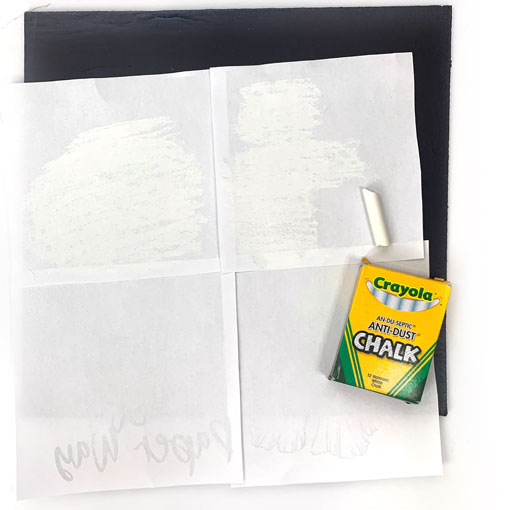
- Hold your template up to the light to ensure your chalk covers any part with a design on the front side.
- After all your chalk is applied, flip your paper over (face), and align it perfectly over your chalkboard.
- Once y'all have it in place, tape it down deeply with washi or painter'southward record (you may need to employ a ruler to straighten the pages).
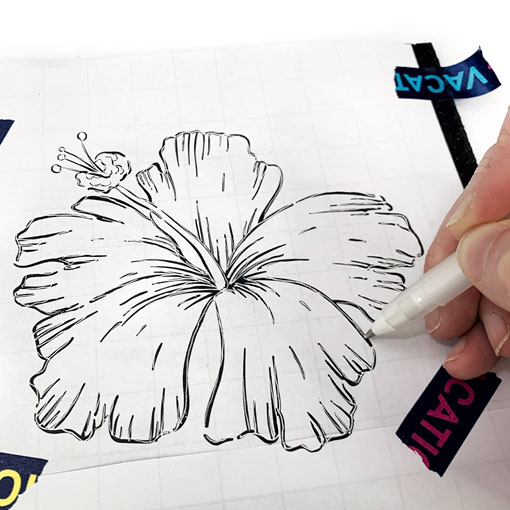
- Use any pen (I utilize a white gel pen), and trace over the whole design of your template — don't press too hard and indent your chalkboard, only press hard enough to make sure the chalk transfers to the next folio.
- Check your progress, by carefully lifting a corner of the page to make certain your chalk marks are transferring to the board.
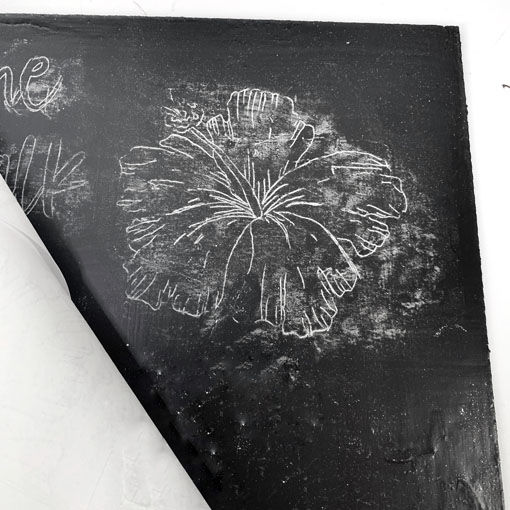
- Stop tracing over the template, and make sure to trace over all the outlines of objects, too every bit areas with different colour tones (hue) and saturation.
- Then carefully remove all the taped newspaper.
- At present you lot're gear up to apply chalk markers and write directly on your chalkboard!
When tracing over your template, brand sure to outline any areas with subtle variations in color, shadow or vibrance. An like shooting fish in a barrel way to know which areas you need to outline is to just imagine how many different pen colors you'll need when it comes fourth dimension to finish the blueprint on the board — if yous'll need a new pen colour, then you lot should outline that area.
That's all there is to it.
Just add chalk to the back of a paper design, then trace over it.
But don't forget:
The con with this method is that information technology can exist difficult to transfer clean lines to your board.
Luckily there'southward a solution — transfer newspaper.

Want to know the cloak-and-dagger to transferring super crispy lines to your chalkboard?
This is where transfer paper joins the political party.
And it'south a GAME CHANGER.
In this second method, instead of chalking the dorsum of your printed template, we're going to slip a sheet of transfer paper between your printable and chalkboard.
And then merely trace on superlative of the printable…
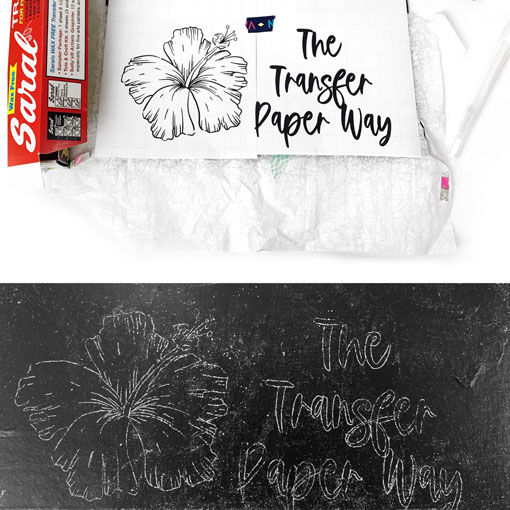
quick pros & cons.
| Pros | Cons |
|---|---|
| Only one extra supply needed (transfer paper). | Transfer paper lines are harder to erase. |
| Yous tin reuse transfer paper several times. | Perfect alignment takes a fleck of actress time (using a ruler helps keep information technology exact). |
| Lines are very crisp and piece of cake to trace on your chalkboard. | It's harder to execute on extra-large boards. |
supplies yous need.
- Your Printed Template
- White Transfer Paper
- Scissors & Record
- Pen
- Chalk Markers
- Ruler (optional)
- Washi / Painter's / Ruled Record (optional)
- Eraser (optional)
the process (transfer paper way).
- Print out your pattern template and record it together (it needs to lucifer the same size as your chalkboard).
- Take hold of your transfer paper and roll out as many sheets as you lot need to completely comprehend your board.
- Lay the sheets (chalky-side downwardly) on your chalkboard, and record downward the edges to secure them in place.
- Lay your template face over the transfer paper (y'all can grab a ruler to confirm your pattern is centered and level).
- In one case you accept information technology in place, tape it down securely forth the edges with washi or painter's tape.
- Apply a pen to trace over every element of your template design (I utilise a white gel pen).
- After every chemical element is traced, remove both your template and the transfer paper.
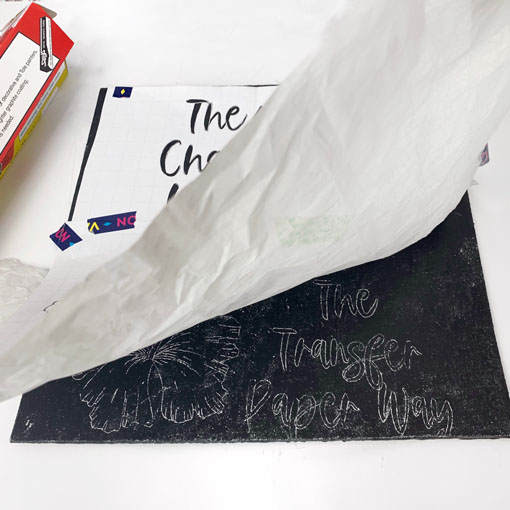
- Curlicue upwards your transfer newspaper and salvage it for another day (you can use it several times).
- At present you're set up to use chalk markers and write directly on your chalkboard — trace over your imprinted design with a chalk mark and add color if needed.
I actually like to use a white gel pen when tracing over my template design — you want to employ a color that writes over blackness so it's easy to see after tracing over black messages.
Now for the ultimate way to transfer your chalkboard pattern…
Imagine this:
Y'all never have to impress templates, mess with your dwelling printer or buy extra ink.
Wouldn't that exist squeamish?
That's where a projector comes into play.
Yes, a projector is expensive, but it's 100% digital and a must for extra-large projects (similar a wall).
And information technology's easier than y'all remember…
In this third method, you're going to need a printed design epitome saved to your smartphone.
quick pros & cons.
| Pros | Cons |
|---|---|
| You can see your tracing progress as y'all go (and chalk pencil is like shooting fish in a barrel to erase). | Projector is a larger investment than the other options. |
| No press any pages, or cutting and taping. | Aligning the projector onto the chalkboard can exist time-consuming. |
| You tin immediately view your design on the chalkboard (before tracing starts). | The more lighting in the room, the harder information technology is to encounter the projection. |
supplies you lot demand.
- Portable Projector (with telephone connection cord)
- Phone (with your sign image)
- Chalk Pencil
- Chalk Markers
- Chair
- Ruler (optional)
- Washi / Painter's / Ruled Tape (optional)
- Eraser (optional)
The projector I utilize is the TopVision make from Amazon (it costs ~ $130). There are several versions online (including a newer version of mine), butmake sure your projector is compatible with your smartphone!
the process (projector manner).
- In Canva, save your design every bit a PNG image with both a white and black background to your figurer.
- Send your PNG images to your phone by e-mail, AirDrop, Pushbullet, text bulletin, etc.
- Grab your chalkboard and lean it against an open wall area.
- Put your projector on a chair (or some other raised surface) facing towards the lath.
- Plug your mobile telephone into the projector and open your design image on your camera scroll (cull either the white or black background image, depending on which one is more visible on the board).
- Suit your projector height and focus settings to get the film to fit perfectly on the chalkboard (this can exist tricky, but take the time to get it correct so it won't budge during the transfer process).
- Take hold of a chalk pencil and trace over as many details and outlines of your projected images as you can on the chalkboard.
- Now turn your projector off.
- Make sure your chalk pencil outlines look good, and so trace them in chalk mark (more than permanent) to finish your lath design.
Not besides hard correct?
All we are doing hither is projecting an image and using a chalk pencil to get your guidelines in identify, and so using a chalk marking to finish the pattern in total and to add color.
Don't forget:
You may need to elevate the projector (on your chair or another surface) AND move the base of operations of your chalkboard further in & out from the wall, to go your projected image to fit only right.
(Just play with all the angles a bit, and you'll become information technology right. 👍)
To move an paradigm from a computer to your mobile phone, yous tin utilise a USB cord or AirDrop (for iPhone) — acquire nearly all your options here.
wrapping up.
Who said transferring a chalkboard design was hard?
Let's recap what we've learned:
At that place are 3 methods you tin choose from when transferring a pattern to your chalkboard.
Use the Chalk Way, if you're on a budget and your printed design is non besides circuitous.
Utilise the Transfer Paper Way, if you lot want cleaner markings to assistance you draw your final blueprint.
Last but non least, use the Projector Style, if y'all desire to become digital and accept a large projection.
Before you go:
What images, fonts, or messages are you lot going to make?
What are you making your sign for — your home, classroom, store?
Allow me know in the comments below. 👇
go out a comment.
Share your thoughts below — you lot stance matters.
Source: https://alachalk.com/chalkboard-transfer/
0 Response to "Using Transfer Paper to Create Art on Chalk Board"
Post a Comment