Weird Painting Art History Lady With Broom Kitchen Witch
As she leans over the gate of a wooden fence a young girl stares directly at the viewer. In her left hand is a broom. The contend appears to surround a well, whose dark, round class is visible in the foreground. The well is flanked by a large overturned bucket on the right and a dark object, possibly a trough, on the left. While the daughter's course is lit strongly from the left, the dark background and fifty-fifty the area effectually the well remain relatively undefined and obscured in shadow.
This entry is a revised version of the text that appeared in the Nationalmuseum catalog of Rembrandt och Hans Tid [Rembrandt and His Age] (Stockholm 1992), no. 83, and the symposium papers published thereafter (Arthur K. Wheelock Jr., "A Girl with a Broom: A Problem of Attribution," in Görel Cavalli-Björkman, ed., Rembrandt and His Pupils [Stockholm, 1993], 142–155). I have benefited greatly from my many conversations with Susanna Pauli Griswold about the issues discussed in this entry. I would also similar to thank Dennis Weller and Melanie Gifford for their helpful comments.
A Girl with a Broom, in large role because of the appealing features of the immature girl and the genre-like character of the subject, has long been admired every bit one of Rembrandt'due south most sensitive depictions of figures from his immediate surround. This bonny model has been identified repeatedly every bit a young servant girl in Rembrandt's household, but her identity remains unknown.
This identification was first proposed by Émile Michel, Rembrandt: Sa vie, son oeuvre et son temps, 2 vols. (New York, 1893), 1:75. It was reiterated past, amongst others, Otto Benesch, "The Rembrandt Paintings in the National Gallery of Art," Art Quarterly 6 (Winter 1943): 26. 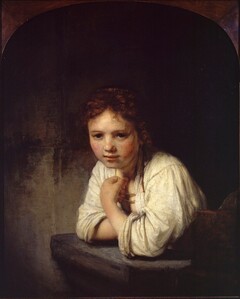 [fig. 1] Rembrandt van Rijn, Girl at a Window, 1645, oil on sheet, Dulwich Picture Gallery, London. Photograph reproduced past permission of the Trustees of Dulwich Picture Gallery
Computer examinations of the physical characteristics of the heads in these 2 paintings have been undertaken at the National Gallery of Fine art. The results accept reinforced the notion that the model was identical. I am particularly indebted to Ambrose Liao and Donna Mann for their enthusiastic research on this projection.
Whether this work was meant every bit a portrait or as a genre scene has been a matter of some discussion. Should it accept been possible to identify the girl, the painting would near certainly be classified every bit a portrait because of the frontal pose and conscientious depiction of the features.
See, for example, Rembrandt'south Titus at His Desk, 1655 (Museum Boijmans Van Beuningen, Rotterdam, inv. no. 512), which would probably be classified equally a genre scene where the sitter not known.
Susan Koslow, "Frans Hals's Fisherboys: Exemplars of Idleness," Fine art Bulletin 57 (September 1975): 429, has associated the crossed-arm pose of the girl with idleness. This interpretation, even so, is non convincing. The type of well depicted appears to be similar to that in The Hamlet Holiday by Daniel Teniers the Younger (1610–1690) (Virginia Museum of Fine Arts, Richmond, no. 56–23). In this painting a broom and a bucket stand up adjacent to the well.
Recent scholars accept doubted the attribution to Rembrandt and some have even speculated that the painting is eighteenth century in origin.
Virtually all scholars since Abraham Bredius, Rembrandt: The Complete Edition of the Paintings, revised by Horst Gerson (London, 1969), 580, no. 378, take doubted the attribution to Rembrandt.
The chief reason that A Daughter with a Broom has been associated with eighteenth-century images is its physical appearance. The surface is deformed in areas, especially in the confront and hands, by pronounced 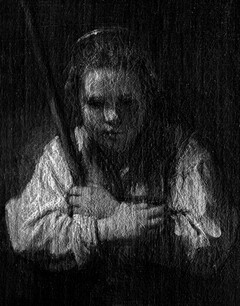 [fig. 2] Raking light, Rembrandt Workshop (Perhaps Carel Fabritius), A Daughter with a Broom, probably begun 1646/1648 and completed 1651, oil on canvass, National Gallery of Art, Washington, Andrew West. Mellon Collection, 1937.i.74
Abraham Bredius, Rembrandt: The Complete Edition of the Paintings, revised by Horst Gerson (London, 1969), 580, no. 378 wrote: "The surface is equanimous of small particles of paint curling slightly at the edges, such as ane observes on pictures which have been exposed to extraordinary heat or on pictures of the eighteenth century. The latter possibility, in the present land of Rembrandt research, should non be excluded." The issue was farther taken upwardly past Hubert von Sonnenburg, "Maltechnische Gesichtspunkte zur Rembrandtforschung," Maltechnik-Restauro 82 (1976): 12. Von Sonnenburg associated the "gerunzelte Farbschicht" with that found in eighteenth-century English paintings. This effect, he wrote, resulted from an excess of drying oil or from the graphic symbol of the medium itself. He questioned whether the painting had been made by a follower of Rembrandt and chosen for a serious scientific assay of the piece of work. 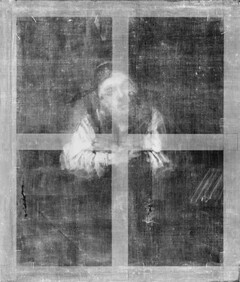 [fig. 3] X-radiograph composite, Rembrandt Workshop (Possibly Carel Fabritius), A Daughter with a Broom, probably begun 1646/1648 and completed 1651, oil on sheet, National Gallery of Fine art, Washington, Andrew Westward. Mellon Collection, 1937.1.74
I would particularly like to give thanks Karin Groen, who analyzed a group of samples taken from this painting and confirmed the assessment of the trouble developed by the Scientific Research department at the National Gallery of Fine art (letter, December 4, 1992, in NGA curatorial files). She specifically noted that medium-rich paint (high oil content) tin can be observed in many of the layers. A dark brownish underlayer, sandwiched betwixt medium-rich layers, contains manganese, probably in the form of umber, which promotes a fine type of wrinkling. Layers near the surface comprise cobalt, which promotes surface drying. Once the surface dries prior to the drying of the underlying layers, wrinkling of the paint occurs. She besides noted the presence of vermilion near the proper right paw that belonged to the later change in the composition.
Although the existence of an earlier form below the girl's caput is adequately easy to distinguish in the Ten-radiographs, evidence of an underlying layer is more difficult to discern for the residual of the trunk. Nevertheless, an earlier shape for the blouse, blocked in with paints with footling density, can be distinguished in various places.
The X-radiographs [run across
The thumb is likewise visible in the X-radiographs.
Whatsoever the explanation for the unusual nature of the paint in the flesh areas, neither technical nor visual evidence provides an argument for removing A Girl with a Broom from the immediate orbit of Rembrandt.
Although a comparable wrinkling effect is not found in the impastos of paintings by Rembrandt, similar problems do exist in the backgrounds of at least two of his works, Abduction of Proserpine (Gemäldegalerie, Berlin; Br. 463), and Alexander (Metropolis Art Gallery and Museum, Glasgow; Br. 480).
Notwithstanding the inherent qualities of A Girl with a Broom, a close comparison of it with ii comparable paintings by Rembrandt—Girl at a Window, 1645, in Dulwich [fig. 1] Rembrandt van Rijn, Girl at a Window, 1645, oil on canvas, Dulwich Picture Gallery, London. Photograph reproduced by permission of the Trustees of Dulwich Picture Gallery 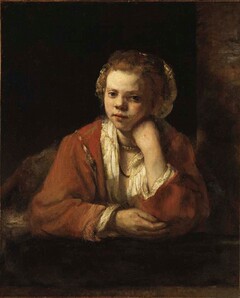 [fig. 4] Rembrandt van Rijn, Servant Daughter at a Window, 1651, oil on canvas, Nationalmuseum, Stockholm
Significant stylistic differences also be betwixt A Daughter with a Broom and Rembrandt'due south Servant Girl at a Window [fig. iv] Rembrandt van Rijn, Retainer Daughter at a Window, 1651, oil on canvas, Nationalmuseum, Stockholm
The contrasts in way of execution between A Girl with a Broom and both of these related paintings are so intrinsic to an artistic arroyo that it seems improbable that A Girl with a Broom was executed by the same hand. The differences between the Washington and Dulwich paintings are such that it does non seem possible to account for them by differences of date, even if the Dulwich painting were executed in 1645 and the Gallery's painting in 1651. It is even more than improbable that Rembrandt would have created such different images equally the Washington and Stockholm paintings in the same year. The signature and date of A Daughter with a Broom, moreover, are certainly doubtable. Although there is no prove to propose that they have been added at a later engagement, they are written in an uncharacteristic form, placed, every bit they are, around the circular inner border of the well.
The signature appears to be integral with the pigment surface, and no varnish has been found between it and the underlying paint.
Information technology is a curious coincidence that the Stockholm Servant Girl at a Window is as well dated 1651. Both paintings were in France in the eighteenth century, every bit was the Dulwich painting. One of these 3 paintings may take been the work described by Roger de Piles in the preface to his Cours de Peinture par Principes (Paris, 1708), 10–xi, every bit quoted in Seymour Slive, Rembrandt and His Critics, 1630–1730 (The Hague, 1953), 129: "Rembrandt diverted himself one solar day by making a portrait of his servant in order to showroom it at his window and deceive the eyes of the pedestrians. . . . While in Holland I was curious to meet the portrait. I plant it painted well and with great strength. I bought it and still exhibit it in an of import position in my cabinet."
Few specifics are known about the nature of Rembrandt's workshop in the late 1640s and early 1650s. Samuel van Hoogstraten (1627–1678), in his Inleyding tot de Hooge Schoole der Schilderkonst (Rotterdam, 1678), indicates that he was active in the master's workshop before he returned to his native city of Dordrecht in April 1648. The fellow students he mentions were
Although no documentary proof has survived that clarifies the different roles of pupil and assistant in Rembrandt's workshop during the 1640s, the more advanced of his students, for example Hoogstraten and Fabritius, would have worked equally assistants in the workshop after they finished their apprenticeship.
Fabritius seems to have studied with Rembrandt in the early 1640s earlier returning to Midden-Beemster in 1643. Virtually nothing is known about him during the late 1640s, but it seems unlikely that he remained in Midden-Beemster the entire fourth dimension without continuing his contact with Rembrandt in Amsterdam. Midden-Beemster is only about thirty kilometers from Amsterdam and was a community that had many ties with Amsterdam. In 1648 or 1649 Fabritius painted the portrait of a wealthy Amsterdam silk merchant, Abraham de Potter (Rijksmuseum, Amsterdam, inv. no. A1591). Past 1650 he had moved to Delft. For further information on Fabritius see Christopher Brown, Carel Fabritius (Oxford, 1981), and Frederik J. Duparc, Carel Fabritius, 1622–1654 (The Hague and Schwerin, 2004).
In this respect their human relationship to Rembrandt would accept been much the same as that of Anthony van Dyck to Peter Paul Rubens during the late 1610s. In those years Van Dyck simultaneously painted in Rubens' style when working in Rubens' studio and in his own personal way when painting in his own workshop.
A Girl with a Broom fits into this scenario. Information technology is one of a number of paintings loosely derived from Rembrandt's Girl at a Window in Dulwich. Hoogstraten was especially fond of this compositional type, if one is to judge from his belatedly 1640s Swain in a Hat, at a Half-Door in the Hermitage.
Fellow in a Hat, at a Half-Door is non signed. It was first attributed to Hoogstraten by Werner Sumowski, Gemälde der Rembrandt-Schüler, v vols. (Landau i.d. Pfalz, 1983), ii:1339, no. 856. The painting was besides cataloged equally by Hoogstraten in Christopher Chocolate-brown, Jan Kelch, and Pieter van Thiel, Rembrandt: The Main and His Workshop: Paintings (New Haven and London, 1991), 356, no. 74. 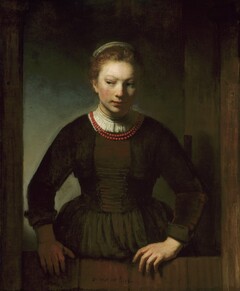 [fig. v] Rembrandt van Rijn (or follower), Young Woman at an Open up Half-Door, 1645, oil on canvas, Mr. and Mrs. Martin A. Ryerson Collection, 1894.1022. Photo © 1994, The Fine art Institute of Chicago. All Rights Reserved
The painting was included in Christopher Brown, Jan Kelch, and Pieter van Thiel, Rembrandt: The Master and His Workshop: Paintings (New Haven and London, 1991), 350, no. 72, as by Hoogstraten. I would similar to thank Martha Wolff at the Art Found for her observations about the differences in technique between these two paintings and for sending me detailed photographs of the Chicago painting. In addition to the Chicago painting, some other Rembrandt School painting from this menses, depicting a immature boy leaning against a metal railing, is in the Cincinnati Art Museum. See Mary Ann Scott, Dutch, Flemish, and German Paintings in the Cincinnati Art Museum (Cincinnati, 1987), 107–110, no. 38. 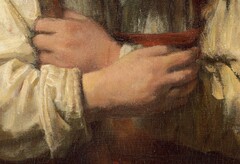 [fig. 6] Detail of hands, Rembrandt Workshop (Possibly Carel Fabritius), A Girl with a Broom, probably begun 1646/1648 and completed 1651, oil on canvas, National Gallery of Art, Washington, Andrew W. Mellon Drove, 1937.1.74
 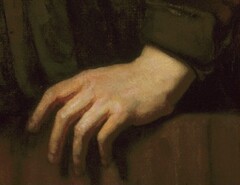 [fig. seven] Detail of left hand, Rembrandt van Rijn (or follower), Immature Woman at an Open up One-half-Door, 1645, oil on canvas, Mr. and Mrs. Martin A. Ryerson Drove, 1894.1022. Photo © 1994, The Art Institute of Chicago. All Rights Reserved
The artist in Rembrandt's circumvolve during this period who was most capable of both the nuanced modeling of the face and hands and the crude bravura brushwork found in the sleeves was Carel Fabritius, just specific comparisons with other works by him are difficult to make because few paintings can be firmly attributed to him during the mid-1640s. Thus only a tentative attribution to him is suggested.
In 1993, at my suggestion, the attribution of this painting was inverse from "Rembrandt van Rijn" to "Carel Fabritius and Rembrandt Workshop," and the painting was exhibited as such in Stockholm (Rembrandt och Hans Tid [Rembrandt and His Age] [Stockholm, 1992], no. 83). The Fabritius attribution, however, was not mostly accepted. A number of colleagues felt that insufficient comparative fabric existed to make a firm attribution. Walter Liedtke, "Stockholm: Rembrandt and His Historic period" (review of the exhibition Rembrandt och Hans Tid), The Burlington Magazine 124 (December 1992): 829–830, believes that the artist of the Chicago painting (fig. 5), which he attributes to Samuel van Hoogstraten, also executed A Girl with a Broom. Egbert Haverkamp-Begemann (personal communication, 1993) would prefer to get out the attribution of the Washington painting every bit "anonymous." 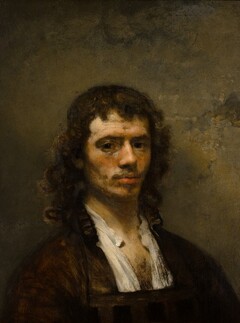 [fig. 8] Carel Fabritius, Self-Portrait, c. 1645–1648, oil on canvas, Museum Boijmans Van Beuningen, Rotterdam. Photograph: Studio Tromp, Rotterdam
I other painting can exist brought into this word, a Portrait of a Woman attributed to Fabritius past the Rembrandt Research Project (RRP).
Stichting Foundation Rembrandt Research Project,A Corpus of Rembrandt Paintings, vol. 3, 1635–1642, ed. Josua Bruyn et al. (Dordrecht, Boston, and London, 1989), C107. The painting and its pendant (Br. 251), which are traditionally identified as portraits of Adriaentje Hollaer and her hubby, the painter Hendrick Martensz Sorgh, are in the collection of the Duke and Duchess of Westminster. Come across too Abraham Bredius, Rembrandt: The Complete Edition of the Paintings, revised by Horst Gerson (London, 1969), 291, no. 370.
For a detail photograph of the easily of the Portrait of a Woman see Stichting Foundation Rembrandt Research Project,A Corpus of Rembrandt Paintings, vol. three, 1635–1642, ed. Josua Bruyn et al. (Dordrecht, Boston, and London, 1989), 677, fig. 4.
The hypothesis that A Daughter with a Broom could have been created during the mid-to-belatedly 1640s by Fabritius in response to Rembrandt'due south Girl at a Window, however, needs to remain extremely tentative because of the 1651 date inscribed on the painting. Fabritius almost certainly would not accept added the signature and date because he had moved to Delft in 1650. It is possible, all the same, that the paradigm was reworked and brought to completion by some other artist at this date. The basis for this hypothesis is the stylistic discrepancy that exists between the execution of the broom, the saucepan, and even the fence surrounding the well, and that of the effigy. Neither the broom nor the bucket is executed with the same surety as the figure itself. The tentative brushstrokes practice non model the forms with bold accents comparable to those found on the girl's blouse. The relationships of scale betwixt the daughter and these objects are also especially discordant.
Technical evidence seems to support the hypothesis that the broom may have been worked up after the initial blocking in of the effigy had occurred. As has been mentioned, an earlier form of the blouse and the girl's left thumb were painted under the broomstick. Whether or not the broom was part of the original concept is of some contend. In the X-radiographs (run across [fig. 3] X-radiograph composite, Rembrandt Workshop (Possibly Carel Fabritius), A Daughter with a Broom, probably begun 1646/1648 and completed 1651, oil on canvass, National Gallery of Fine art, Washington, Andrew W. Mellon Collection, 1937.1.74
The only possibility that I can come up with is that the combined forms may have been a reserve for an implement with a horizontal piece at the end of the handle.
One chip of technical testify that links the signature and date, the broom, and the saucepan concerns their distinctive reddish orange accents, which have a vermilion component. Similar accents also announced on the daughter'due south curls and on her shoulder to the left of the broom, indicating that these other areas of the painting may accept been finalized at this time every bit well.
This observation has been confirmed through Karin Groen's analysis of the pigment layers. Come across annotation 8.
Arthur K. Wheelock Jr.
Apr 24, 2014
Source: https://www.nga.gov/collection/art-object-page.81.html
0 Response to "Weird Painting Art History Lady With Broom Kitchen Witch"
Post a Comment